

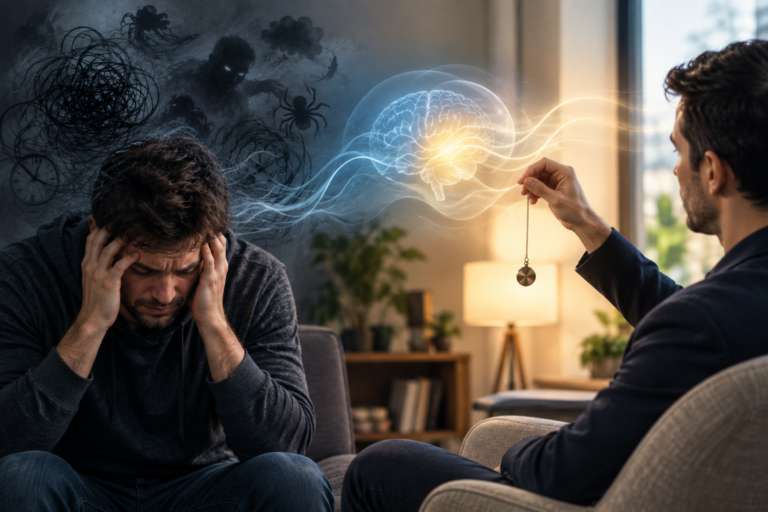
He knew the plane was safe. He could recite the statistics. He’d watched the documentaries. He’d read the safety briefings. He knew with absolute intellectual certainty that he was more likely to be injured driving to Brisbane Airport than sitting in seat 34C.
None of that mattered. His body didn’t care about statistics.
The moment the cabin doors closed, his heart rate doubled. His palms went slick. His vision narrowed. His chest tightened until breathing felt like trying to suck air through a coffee stirrer. Every tiny noise the landing gear retracting, a ding from the cabin crew, a change in engine pitch sent a jolt of electric terror through his nervous system.
James hadn’t flown in four years by the time he called me. He’d missed his grandmother’s funeral in Melbourne. He’d watched his wife take the kids to Bali without him. He’d turned down a promotion that required interstate travel. His GP had prescribed Valium, which helped him board a plane once foggy, nauseous, white-knuckled but he’d sworn never again.
“I know it’s irrational,” he said in our first conversation. “That’s what makes it worse. I know it doesn’t make sense. But knowing doesn’t stop it.”
He’s right. And understanding why knowing doesn’t stop it is the key to understanding why hypnotherapy works for phobias and panic attacks when almost nothing else does.
Why your fear doesn’t care about facts
Here’s the neurological reality of a phobia. When your brain perceives a threat whether that threat is real or imagined your amygdala fires before your conscious mind has time to evaluate the situation. The amygdala doesn’t think. It doesn’t reason. It doesn’t check statistics. It detects a pattern that was previously associated with danger, and it launches a full stress response: adrenaline, cortisol, elevated heart rate, rapid breathing, tunnel vision.
This happens in milliseconds. Your conscious mind the part that knows the plane is safe doesn’t even get consulted. By the time you’re thinking “this is irrational,” your body is already in full fight-or-flight mode.
This is why telling someone with a phobia to “just relax” is like telling someone having a sneezing fit to “just stop.” The response isn’t under conscious control. It’s running on subconscious autopilot, and it’s been reinforced every time the phobic response fired and your brain recorded it as a survival success.
Your brain doesn’t know you survived because the plane was safe. It thinks you survived because you were terrified. So it keeps the terror programme running. Getting better, in its logic, would be getting less safe.
Now here’s the critical insight: the association between the trigger and the fear response was created at the subconscious level often in a single moment and it can only be effectively changed at the subconscious level. That’s what hypnotherapy does.
The phobias I see most often in Brisbane
Every phobia is unique to the person, but certain fears come through my Hamilton clinic regularly:
Fear of flying is probably the most life-limiting phobia I treat. Brisbane is a long way from everywhere. When you can’t fly, you can’t visit family interstate, you can’t take international holidays, and career opportunities that require travel simply evaporate.
Claustrophobia and crowd anxiety show up frequently fear of lifts, MRI machines, packed trains, shopping centres at Christmas, music festivals. Brisbane’s growing density and the upcoming development around the 2032 Games infrastructure mean more crowds, more enclosed spaces, more triggers.
Animal and insect phobias spiders, snakes, cockroaches, dogs are surprisingly debilitating in Queensland, where encountering wildlife is part of daily life. I’ve had clients who couldn’t open their wheelie bin, couldn’t garden, couldn’t walk to their letterbox after dark because the possibility of encountering a spider paralysed them.
Heights, water, driving, and medical phobias also respond well to hypnotherapy. Fear of needles. Fear of the dentist. Fear of vomiting (emetophobia, which is more common and more isolating than most people realise). Each one has a subconscious programme behind it, and each one can be addressed.
How hypnotherapy resolves phobias
The process is straightforward, even though what happens underneath is profound.
We start with a conversation. I need to understand your specific fear not just the trigger, but the full experience of it. What does your body do? When did it start? Are there situations where it’s better or worse? Have you tried other treatments? This isn’t a box-ticking exercise it tells me how your subconscious has structured the fear, so I can tailor the session specifically to you.
Then I guide you into a deeply relaxed state. You remain aware and in control the entire time. From that calm place, we access the subconscious pattern driving the phobia.
Often not always, but often the subconscious reveals a specific origin moment. A turbulent flight in childhood that was never processed. A spider on the pillow aged three. Getting stuck in a cupboard during a game of hide and seek. Being bitten by a dog that appeared friendly. These moments can be so ordinary that you’d never consciously connect them to your adult phobia. But your subconscious made a rule in that moment, and it’s been enforcing it ever since.
In hypnotherapy, we don’t erase the memory. We help your subconscious recontextualise it. The spider on the pillow wasn’t dangerous you were three, it was startling, but you were safe. The turbulent flight landed safely. The cupboard door opened. Your subconscious updates the rule, and the phobic response loses its fuel.
Some phobias resolve remarkably quickly one or two sessions. More complex or layered fears may take a few more. But the shift, when it comes, is unmistakable: the trigger is still there, but the terror isn’t. You can look at the spider, board the plane, step into the lift, and feel for the first time calm.
Living around your fear is exhausting. Let’s address it directly.
If a phobia or panic attacks are limiting your life, give me a call on 0447 715 815 or email marie@hypnotherapyinbrisbane.com.au.
Panic attacks: when fear arrives without a trigger
Phobias have identifiable triggers. Panic attacks don’t always cooperate that neatly.
Some of my clients experience panic attacks that seem to come from nowhere standing in a queue, sitting at their desk, driving on the M1, watching television. One moment they’re fine. The next, their heart is hammering, their chest is tight, they can’t breathe, and they’re convinced something catastrophic is happening. Some have called ambulances genuinely believing they were having a heart attack.
The attacks themselves are terrifying. But what’s often worse is the fear of the next one. This meta-anxiety the anxiety about being anxious can shrink a person’s world dramatically. They stop driving in case it happens behind the wheel. They avoid social situations. They map escape routes in every room they enter. They live in a permanent state of hypervigilance, waiting for the next wave.
Hypnotherapy is particularly effective for panic attacks because the panic response is, fundamentally, a subconscious process. Your amygdala is firing threat alerts based on patterns your conscious mind can’t see. In hypnotherapy, we can identify what those patterns are they might be connected to a past trauma, a period of overwhelming stress, a subconscious belief about safety and help your nervous system recalibrate.
Clients who’ve experienced panic attacks for years often describe the post-hypnotherapy experience with the same phrase: “I keep waiting for it to come, and it doesn’t.” The absence of fear, after living with it so long, can feel almost disorienting. But it settles. And what replaces it is something they’d forgotten was possible: ordinary calm.
Getting help doesn’t require a diagnosis
You don’t need a psychiatrist’s referral or a formal phobia diagnosis to come and see me. If a fear any fear is limiting your life, avoiding it is costing you, and you’re ready for something to change, that’s enough.
I see clients at my Hamilton clinic (Hamilton Health Hub, 33 Remora Road, Hamilton QLD 4007) and online via Zoom. For phobias that are triggered by travel fear of driving, fear of leaving the house online sessions are particularly valuable as a starting point.
Call me on 0447 715 815 or email marie@hypnotherapyinbrisbane.com.au.
Your fear told you it was keeping you safe. It was wrong. Let’s update the programme.
Frequently asked questions
Can hypnotherapy really cure a phobia?
I’m careful with the word “cure” because every person is different. What I can tell you is that many clients experience a complete resolution of their phobic response the trigger remains but the fear doesn’t. For others, the fear reduces significantly enough that it no longer limits their life. Results depend on the individual and the nature of the phobia.
How many sessions does it take to treat a phobia?
Simple phobias (fear of a specific animal, object, or situation) often respond within one to three sessions. More complex fears or phobias layered with general anxiety or trauma may benefit from additional work. I’ll be upfront about what I think your specific situation requires.
What if my phobia has a traumatic origin will I have to relive the trauma?
No. Hypnotherapy is a gentle process. You don’t need to relive traumatic events to resolve them. We work with the subconscious to recontextualise the memory updating its meaning and the response attached to it without forcing you to re-experience distress.
Can hypnotherapy help with panic disorder?
Yes. Panic attacks are driven by a subconscious threat response firing inappropriately. Hypnotherapy helps identify the underlying patterns and recalibrate the nervous system’s response. Many clients experience a significant reduction in both the frequency and intensity of panic attacks.
Is it safe? Will I lose control?
Completely safe. You remain fully aware and in control throughout. You can speak, open your eyes, and stop the session at any point. Clinical hypnotherapy is nothing like stage hypnosis it’s a therapeutic process conducted by a trained, Government Accredited practitioner.
My phobia feels embarrassing will you judge me?
Never. I’ve worked with people afraid of butterflies, balloons, cotton wool, vomiting, motorways, and many things in between. No fear is too small or too strange. If it’s real to you, it’s real and it deserves to be treated with respect.